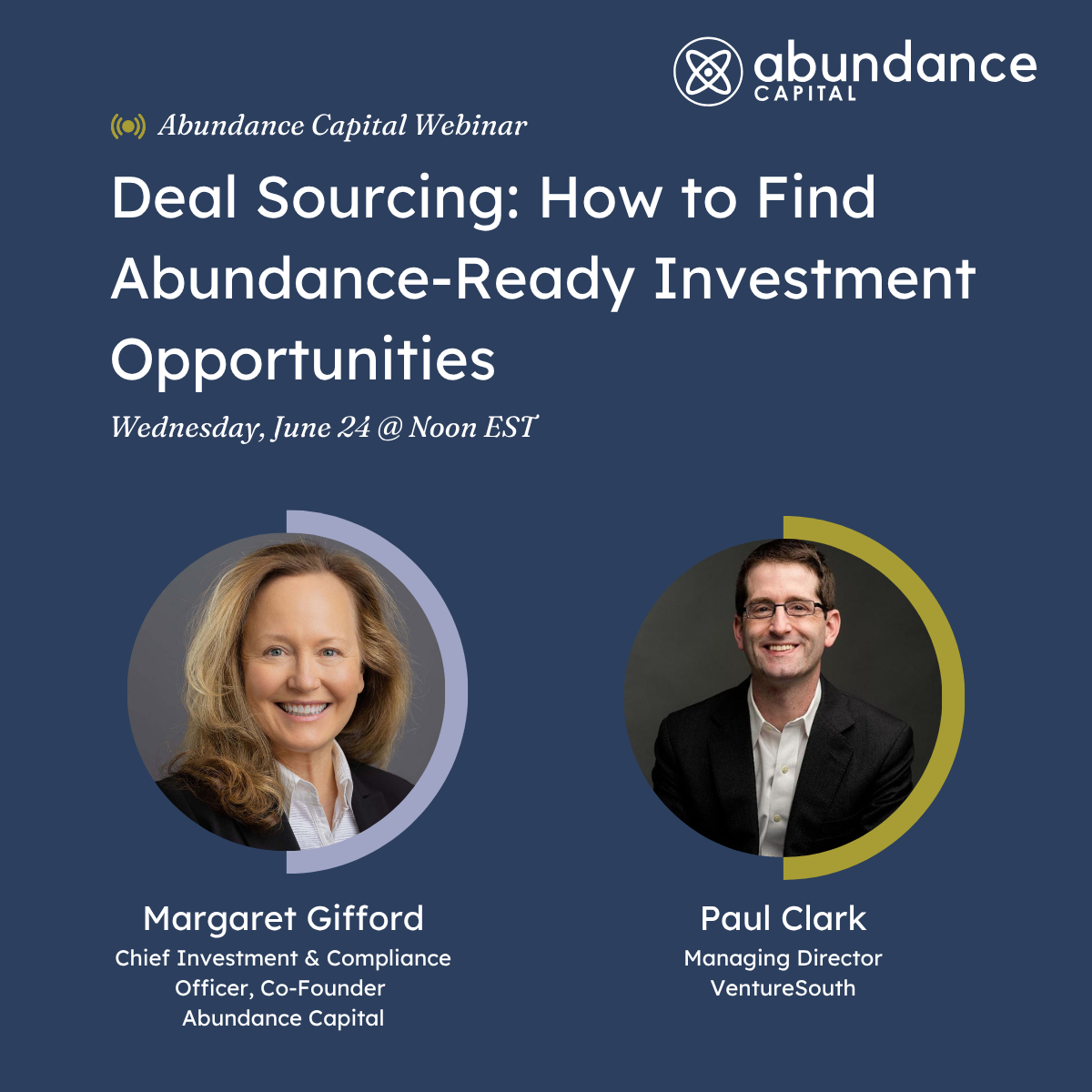
Deal Sourcing: How to Find Abundance-Ready Investment Opportunities
How do you find a good impact investment, and how do you know it's right for your donor-advised fund? In our first Abundance Capital webinar, Margaret Gifford (Chief Investment and Compliance Officer and Co-Founder, Abundance Capital) sits down with Paul Clark (Managing Director, VentureSouth) for an honest conversation about how deal sourcing actually works, what makes a DAF a different kind of tool, and how to spot opportunities in your own community. We cover building your impact thesis, the do's and don'ts of investing and lending with a DAF, how professional angel investors find and evaluate deals, the red flags that lead to a no, and how Abundance Angels can work alongside VentureSouth. Abundance Capital is a public charity helping individuals do more good with their philanthropy by widening the toolkit beyond grants. Learn more at abundancecap.org. Reminder: this conversation is not investment advice.
Recap of our June 24 webinar with Margaret Gifford (Chief Investment and Compliance Officer and Co-Founder, Abundance Capital) and Paul Clark (Managing Director, VentureSouth).
Reminder: this educational webinar is not and should not be considered investment advice.
For our first formal Abundance Capital webinar, we tackled the question our Angels said they most wanted answered: how to actually find and choose the right investment opportunities, and how to spot them in your own community. Margaret sat down with Paul Clark of VentureSouth for an honest, practical conversation.
The DAF is a different kind of tool
A donor-advised fund is a charitable giving vehicle administered by a public charity. You make a tax-deductible contribution, invest or lend those funds tax-free, and recommend grants. When you transfer money to Abundance, it becomes an irrevocable gift. You retain the right to advise on where it goes, and Abundance holds the final yes-or-no under the rules that govern us. Everything we deploy has to measurably build sustainable, equitable communities.
Margaret framed the opportunity simply. Hundreds of billions of dollars sit stuck inside donor-advised funds across the country. Abundance exists to unstick that money by widening the toolkit beyond grants, so individuals can do more good with their philanthropy.
Because you have already given the money away, the risk profile is genuinely different. This is patient, risk-tolerant, concessionary capital. It can still be at market rate, but it should always work toward a broad societal benefit, not just a return.
Start with your "why"
Before any deal, build your impact thesis. Why use a DAF rather than your regular money? What change do you want to see, and how will you measure it? How big, what structure, and is there room to syndicate with other Angels?
Margaret encouraged everyone to think in terms of a portfolio rather than one deal at a time. Consider how you might structure a million dollars of commitments toward something you care about, like housing, and build from there.
The do's are straightforward: write your mission statement and investment thesis, network for deal flow, work with the Abundance team, think big, and give ample time for review. The don'ts matter just as much: do not park the money and forget it, do not self-deal or create private benefits, and never try to skip the regulatory reviews.
One point deserves emphasis. Abundance does not perform true due diligence and is not permitted to act as an investment advisor. A yes from us means a deal is impact-forward and legal, not that it has been vetted. Your own diligence is required. That is exactly why partnering with a group that does real diligence, like VentureSouth, can be so valuable.
What impact can look like
Margaret shared an example from her earlier work, growing a fund from $3.4 million to $30 million. Every dollar invested generated roughly $7 in local food purchases and $28 in sales for the food enterprises they backed. Her larger point: a return is only a proxy for impact. Even when a company fails, the right question is what changed in the community. Failing forward still left real good behind.
How professional investors find deals
Paul gave a candid look inside VentureSouth, a Greenville-based angel investment firm that has been at this for nearly 20 years. Since 2008, they have invested nearly $100 million in more than 130 companies across the Southeast, typically at early-stage rounds of roughly $500,000 to $1.5 million. They work as a matchmaker between people who want to invest and founders raising capital.
There are two ways to source deals, Paul explained: go find them, or let them come to you. VentureSouth leans toward the active side.
Being active means showing up where founders already are, both physically and at events. That includes co-working spaces across multiple towns, startup competitions of every size, from 1 Million Cups to large conferences, and less-obvious industry gatherings that surface different kinds of deal flow. It also means staying close to the people around founders, the attorneys, accountants, and incubators, and talking about angel investing constantly, because you never know where the next opportunity will come from.
The passive side compounds over time. Years of showing up build a reputation that brings deals inbound. Other investors share rounds they cannot fully fund, and VentureSouth returns the favor. Between the two, they look at hundreds to thousands of companies a year.
Make money, have fun, do good
That is VentureSouth's motto, and Paul noted the order is deliberate. The firm has to generate returns to remain in operation. Most members do not join for impact; only about 15 percent come specifically to do good, yet the deals tend to do good anyway because of what they invest in. Sometimes that is obvious, like a company treating a disease. Sometimes it is a company that now employs 50 people at a decent wage in a place that did not have those jobs before. Paul pointed out that net new jobs largely come from small, early-stage startups.
Knowing when to say no
Asked about red flags, both speakers were direct. Margaret said they surface fast for Abundance, because every deal has to point to a clear greater good if it succeeds. She shared a useful prompt from investor Barry Givens of CoLab Capital: "What happens if you're successful?" When VentureSouth has already diligenced a deal under standardized terms, the compliance review on the Abundance side goes much more smoothly.
Paul's easy passes are deals that simply do not fit the criteria: outside the Southeast, the wrong size, or asking for a loan. The harder, non-negotiable one is trust. Any sign that a founder is not being truthful, and they walk away. Beyond that, startups carry endless red flags by their nature. Experienced investors learn to overlook the "orange flags" because they are risk-tolerant by design. As Paul put it, if you do not want to take a risk or two, this is not the asset class for you.
Staying close to the companies
VentureSouth keeps an open, active relationship with the companies it backs, both to know what is happening and to be genuinely helpful through connections and expertise. Even when they cannot solve a problem, understanding what is going on is a good place to start.
How this works with Abundance
If you see an opportunity you like, including in VentureSouth's weekly emailed list, the process is simple: send it to Margaret for vetting (or any Market Lead or Abundance Team Member). She will take a quick look to see whether the impact is intrinsic to the company, the way it is with a cancer drug or solar, and go from there. The same path works for deals you source yourself, and for Angels who are not in the Southeast.
A few attendees asked about sidecar funds. The short version: a sidecar can make diversification easier for an investor, offering a smoother route to the roughly 22-company portfolio one of our Angels is working toward, though it changes little for the company receiving the capital. Abundance has explored the idea from several angles.
Looking ahead, the collaboration between Abundance and VentureSouth is still informal. The group floated a more consistent approach, with market ambassadors sitting in on partner calls to listen for good fits, tied to the catalytic fund work already underway.
Thank you
Thank you to Margaret, to Paul and VentureSouth, and to every Angel who joined and asked such thoughtful questions. This was the first of many. Tell us what you would like to learn about next. There is a lot of good out there, and a lot of abundance.
A recording of the session is available for anyone who could not join us live.